Automatic ECG import
Reads your ECGs directly from Apple Health. If you like, the app lets you know as soon as a new ECG arrives.
SSRI QT Tracker measures QT and heart-rate-corrected QTc from the ECGs in Apple Health – for example from your Apple Watch. Ideal when you start an SSRI or another QT-prolonging medication and want to share your trend with your doctor.
One-time purchase · no subscription · no ads
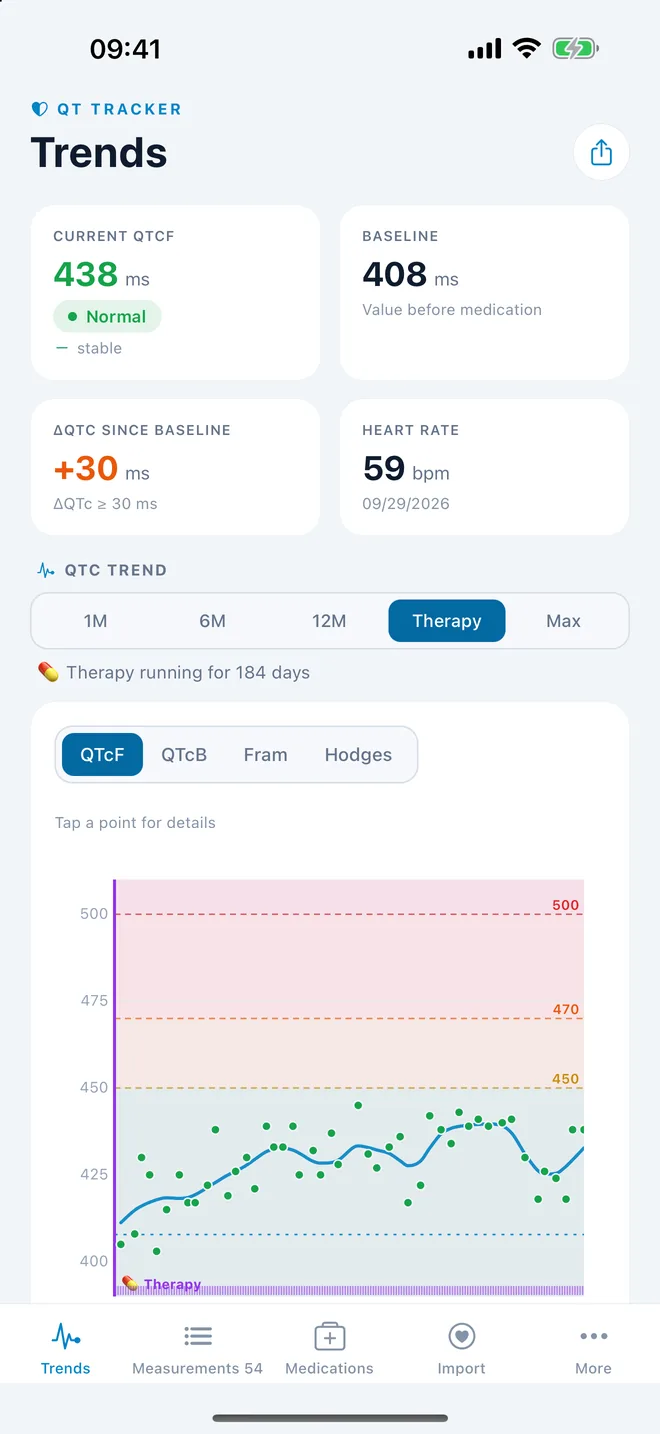
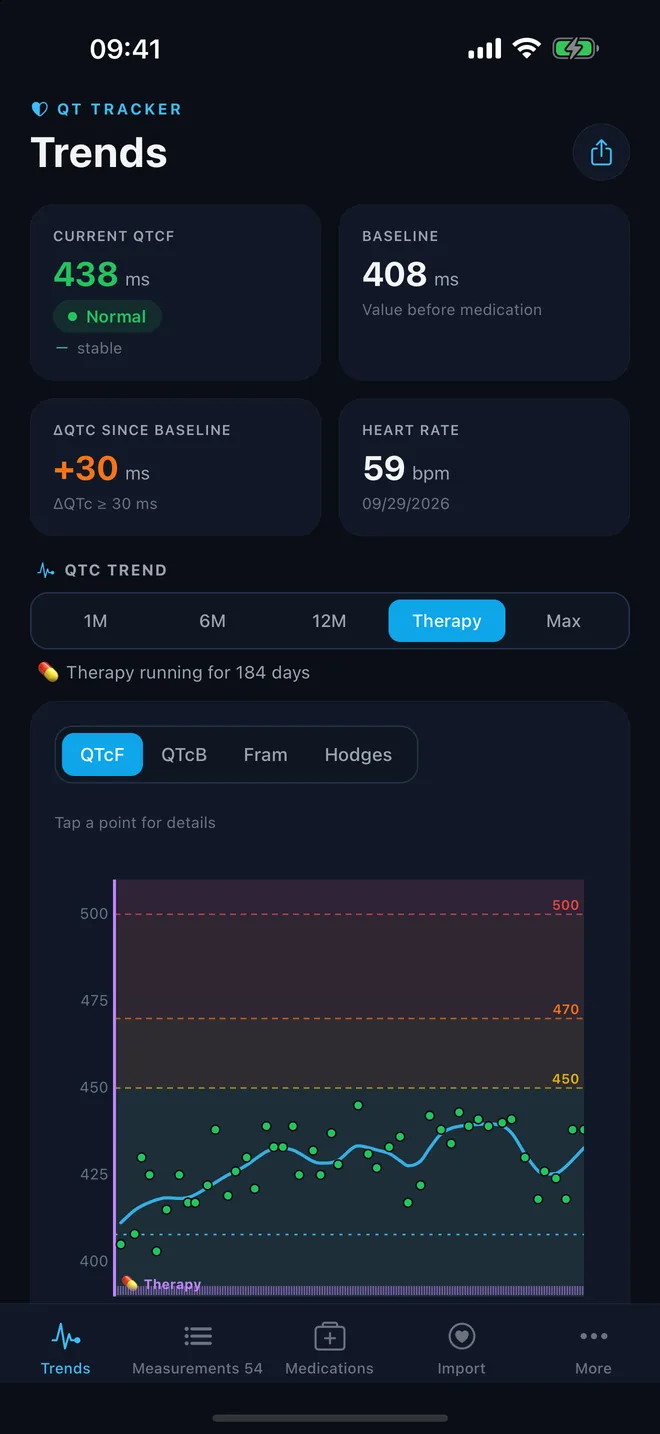
Trend with risk zones at 450 · 470 · 500 ms
Scan with your iPhone camera
Take a 30-second ECG as usual, for example with your Apple Watch. It lands in Apple Health automatically.
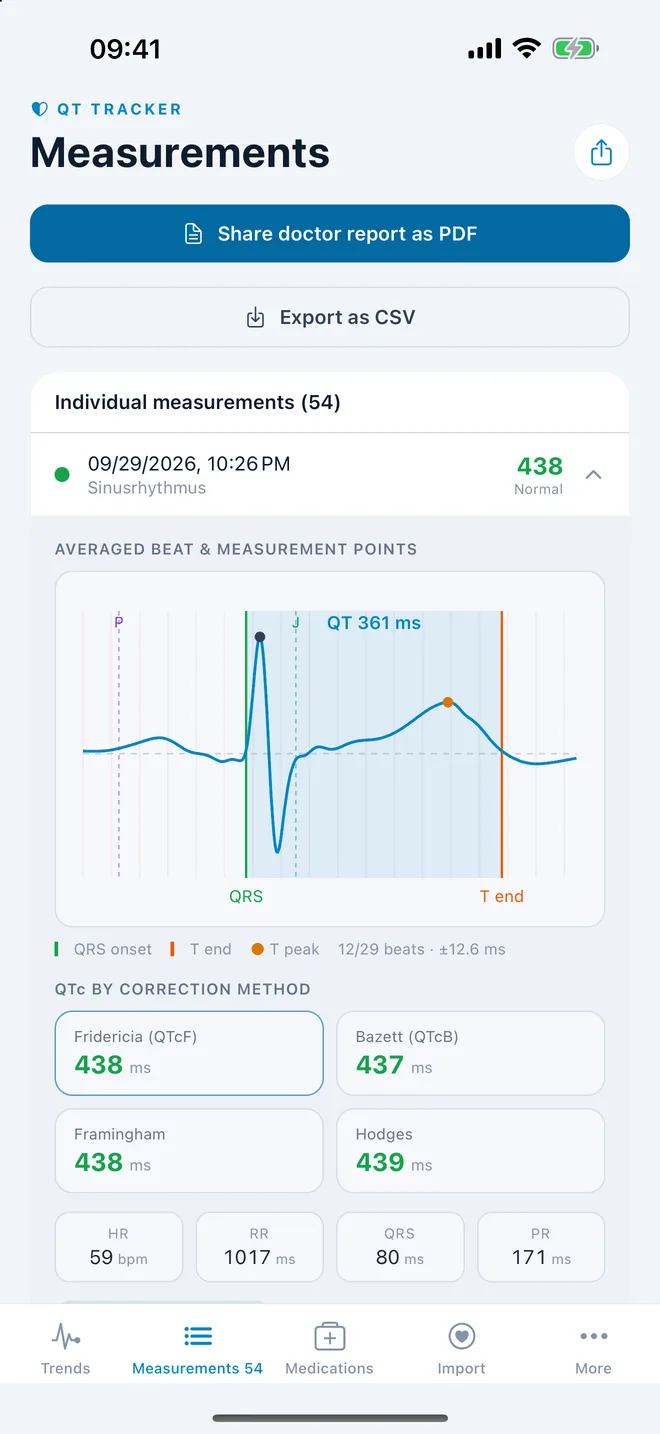
QT Tracker averages all beats into one low-noise beat and finds QRS onset and T-wave end with the tangent method.
Every value lands in your trend chart – with risk zones, baseline and therapy markers. If you like, the app tells you about new ECGs on its own.
Two short screen recordings of QT Tracker 1.1, made with sample data.
Tap a section of the averaged heartbeat – or play the measurement as an animation.
From QRS onset to T end: the complete electrical work of the ventricles. Typical values are about 350 to 450 ms.
The faster your heart beats, the shorter QT gets. QTc converts the value to 60 beats per minute – only then do measurements become comparable. Try it:
Corrected QTc
For illustration only, not a diagnosis. Limits as in the app: men 450 / 470 / 500 ms, women 460 / 480 / 500 ms.
Switch range and formula, tap the points. The data is made up, the chart works like the one in the app.
Tap a point for details
Reads your ECGs directly from Apple Health. If you like, the app lets you know as soon as a new ECG arrives.
Averaged beat, QRS onset and T end via the tangent method – every measurement with visible measuring points.
Fridericia, Bazett, Framingham and Hodges side by side. You decide which one is your reference.
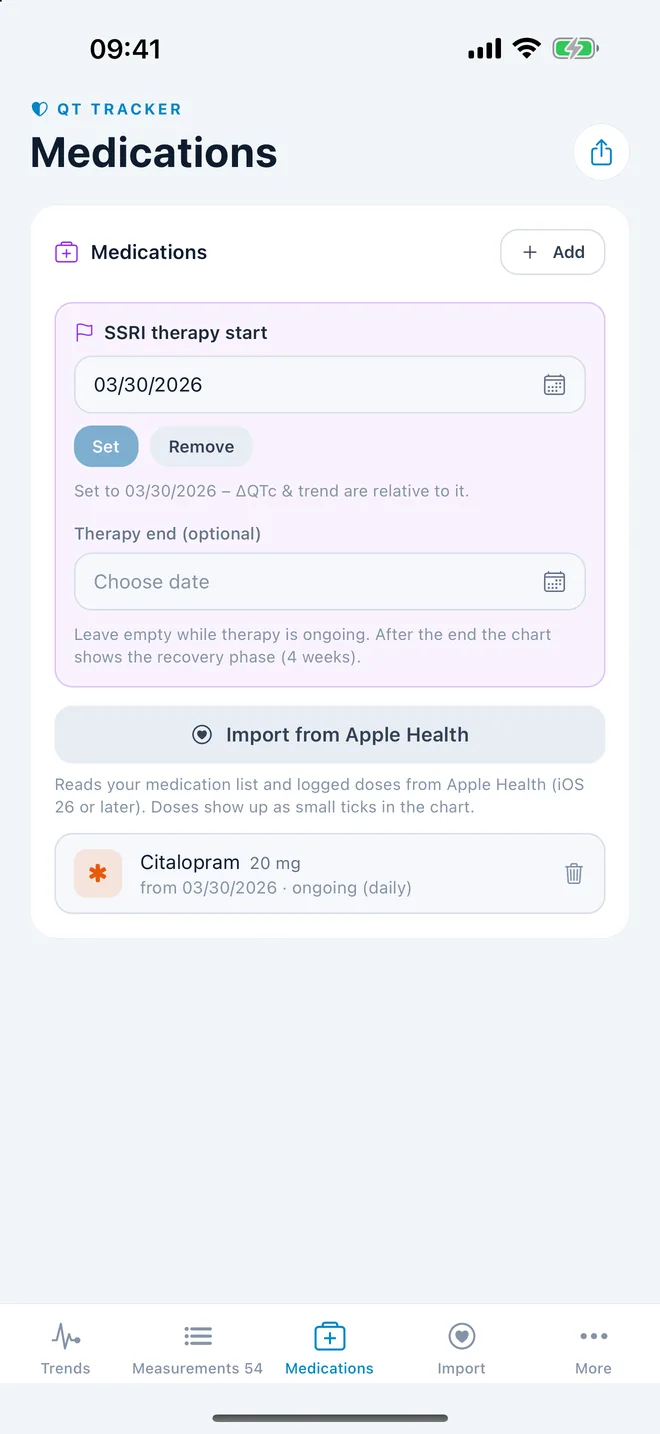
Therapy start and end in the chart, a day axis from the start and a four-week recovery phase after stopping.
Imports your medications including logged doses from Apple Health (iOS 26 or later). Doses appear as fine ticks in the chart.
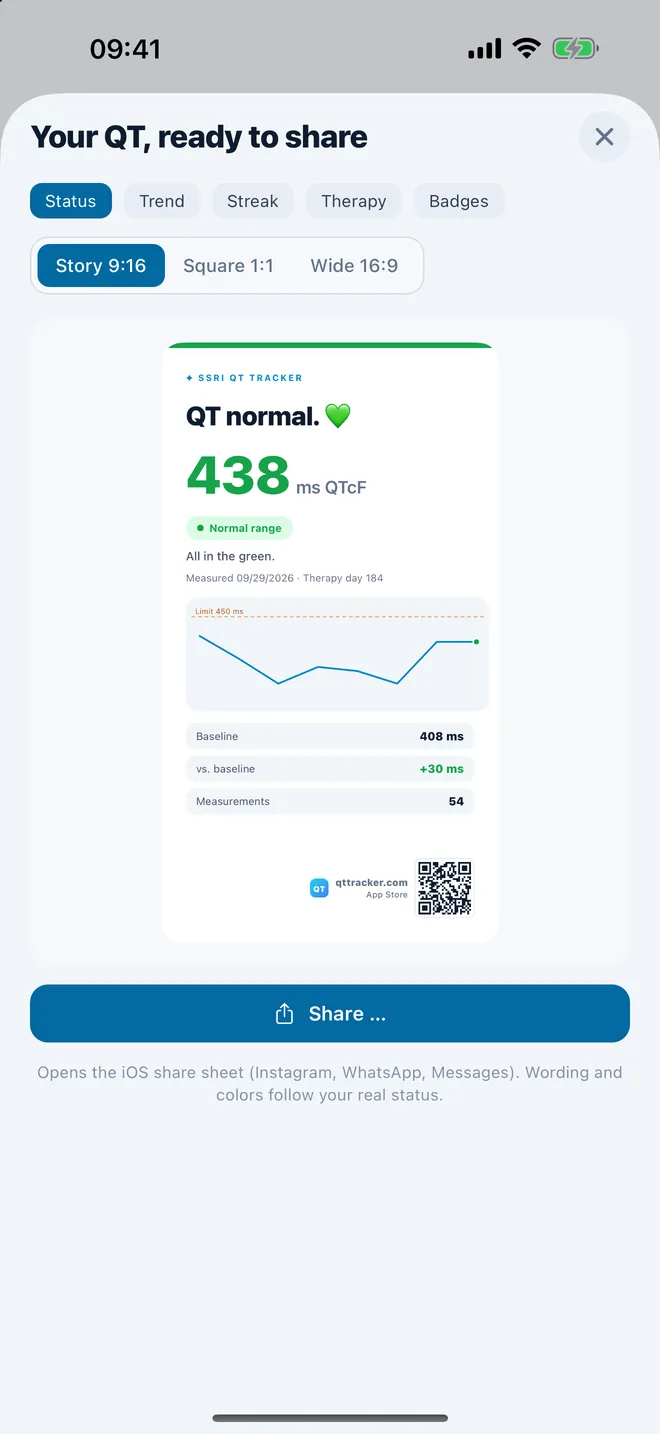
Status, trend, streak, therapy or badges as an image for story, square or wide format – without raw data.
Summary, charts, ECG beats and measurement table – in A4 or as an English US report in Letter format.
Resting heart rate and HRV (SDNN) from Apple Health as a trend right below your QTc.
Your value before medication – and how far your QTc moves away from it. Alerts at +30 and +60 ms.
Gentle reminders so your trend gets enough data points.
All measurements as a spreadsheet – for your own analysis or your clinic.
Follows your iPhone's appearance and runs on iPhone and iPad.
One tap turns your trend into a print-ready QTc report. Hand it to your doctor – or keep it with your records.
Page 1 of 3 · Tap to turn the page
Sample with made-up dataThe QT interval is the time the heart's ventricles need to discharge and recharge electrically. Because it naturally shortens when the heart beats faster, it is normalised to 60 beats per minute – this gives the corrected QT interval, QTc.
Some SSRIs – above all citalopram and escitalopram – can prolong the QT interval in a dose-dependent way. A markedly prolonged QTc raises the risk of a rare but serious heart rhythm disorder called torsades de pointes. That is why prescribing information advises caution, dose limits and, for patients at risk, ECG checks. Regular self-recorded ECGs make a personal trend visible early – and bring real data to your appointment.
Risk zones (men)
For women the limits are 460 / 480 / 500 ms. The app also watches the rise compared with your baseline (ΔQTc ≥ 30 ms or ≥ 60 ms).
QTc = QT / RR1/3The standard – robust across a wide heart-rate range.QTc = QT / RR1/2The classic formula, the most widely used in clinics.QTc = QT + 0.154 · (1 − RR)Linear correction from the Framingham Heart Study.QTc = QT + 1.75 · (HR − 60)Linear correction based on heart rate.All analysis runs on the device. The app never connects to a server.
No sign-up, no login, no email address. Install and go.
No analytics, no ads, no tracking SDKs. Apple's privacy label: Data Not Collected.
Methodology, sample report, limitations and references – a concise overview for physicians and pharmacists.
The app reads ECG recordings from Apple Health, averages the heartbeats into one low-noise beat, measures the QT interval with the tangent method and calculates the heart-rate-corrected QTc using Fridericia, Bazett, Framingham and Hodges. All values appear as a trend with risk zones, baseline and therapy markers.
With any single-lead ECG in Apple Health – for example from an Apple Watch Series 4 or later. The app runs on iPhone and iPad with iOS 15.1 or later and is available in 31 languages.
Yes. The app syncs with Apple Health whenever you open it. You can also turn on a notification that appears as soon as a new ECG arrives – one tap and it is analysed.
Yes, on iOS 26 or later. The app imports medications including start, end and logged doses. You can of course also set the therapy start by hand.
QT Tracker averages many beats of a recording and applies the tangent method – the same approach used in clinical QT studies. Still, a measurement from a single-lead ECG can differ from a 12-lead ECG read by a physician. Treat the values as your personal trend, not as a diagnosis.
No. The app works 100% offline on your device. No server, no cloud, no account, no analytics. Share cards and PDF reports are created on your iPhone and only go where you send them.
Only a summary: status, trend, streak, therapy day or badges – optionally with your first name. No raw data or ECG curves are included.
A small one-time purchase on the App Store, for example $0.99 in the US. No subscription, no ads, no in-app purchases. Demo mode lets you explore the app even without your own ECGs.
No. SSRI QT Tracker is not a medical device and does not replace a physician's ECG interpretation or a diagnosis. If you have symptoms or a QTc of 500 ms or more, seek medical advice – and never stop an SSRI on your own.
One-time purchase · no subscription · 100% offline and private