Demo mode
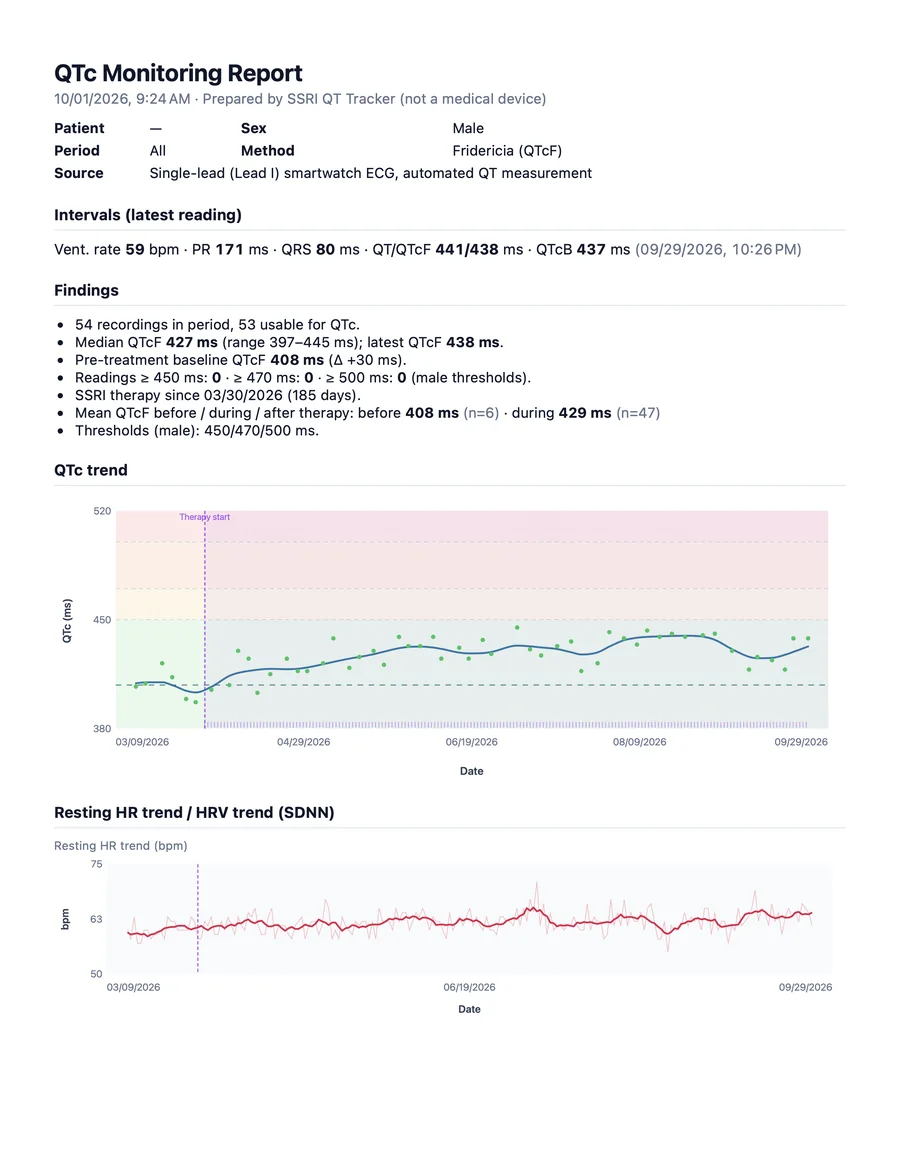
The app can be explored with sample data, without your own ECGs – a quick way to see the report and the trend yourself.
App Store →QTc Tracker is a self-monitoring diary for people taking QT-prolonging medication – above all citalopram and escitalopram. The app analyses the single-lead ECGs in Apple Health and summarises the QTc trend in a report that patients bring to their appointment.
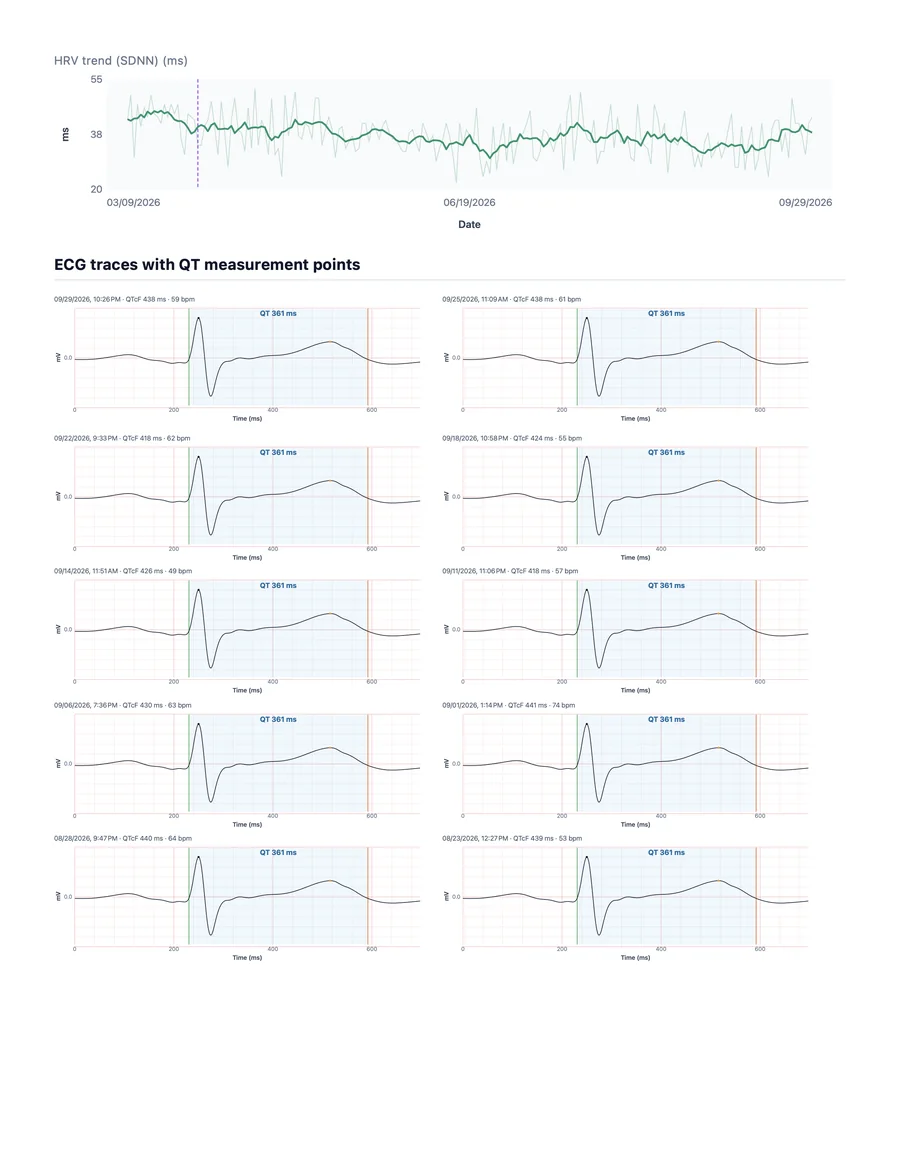
The analysis is deliberately transparent: every measurement shows the averaged beat with the measuring points that were set.
Removal of baseline wander and light low-pass smoothing.
Pan-Tompkins principle: derivative, squaring, moving-window integration and an adaptive threshold.
Each beat is correlated with a median template. The cleanest ~80% (r ≥ 0.8) form the averaged beat – ectopic beats and artefacts drop out.
From the steepest QRS slope back to the stable isoelectric PR segment.
Tangent at the steepest point of the descending T-wave limb; its intersection with the isoelectric line is the T end (tangent method).
QT dispersion across individual beats (standard deviation). Recordings with a heart rate above 120 bpm or an implausible QT are flagged and excluded from trend, baseline and risk statistics.
The averaged beat with QRS onset and T end appears in every report – here interactively, including the tangent method.
From QRS onset to T end: the complete electrical work of the ventricles. Typical values are about 350 to 450 ms.
The report is created on the iPhone and passed on by the patient – by email, messenger or as a printout.
Page 1 of 3 · Tap to turn the page
Sample with made-up dataThe app is for self-monitoring. It does not diagnose and does not replace ECG monitoring as required by the prescribing information.
The automatic measurement has not yet been systematically validated against the 12-lead ECG. We are looking for partners to do so (see below).
In a 12-lead ECG, QT is usually measured in the lead with the longest QT. Values from a single lead may differ, typically being shorter.
Flat, biphasic or U-wave-overlapped T waves make T-end detection harder. That is why every averaged beat is shown for review.
In atrial fibrillation, bundle branch block or paced rhythm, QTc values are of limited value. Rate correction is meaningful between about 45 and 120 bpm.
| Classification | Men | Women |
|---|---|---|
| Normal | < 450 ms | < 460 ms |
| Borderline | 450–469 ms | 460–479 ms |
| Prolonged | 470–499 ms | 480–499 ms |
| Markedly prolonged | ≥ 500 ms | ≥ 500 ms |
In addition, a rise of more than 60 ms over baseline is considered a warning sign. Limits according to AHA/ACCF/HRS (2009) and Drew et al. (2010).
The app can be explored with sample data, without your own ECGs – a quick way to see the report and the trend yourself.
App Store →One page with methodology, report contents and limitations – for your waiting room or for colleagues.
PDF ↓We are looking for clinics and practices to accompany a comparison against the 12-lead ECG – for example as part of a doctoral thesis.
Get in touch →Would you like to present the app in your clinic or practice, give feedback on the methodology or accompany a validation study? Please write to us.
Thresholds, correction formulas and measurement method are based on these publications:
No. The app is a self-monitoring diary. It does not diagnose, gives no treatment recommendations and does not replace ECG monitoring as required by the prescribing information. Abnormal values should be checked with a 12-lead ECG as usual.
With manual measurement, studies show good agreement between Apple Watch QT intervals and the 12-lead ECG (e.g. Strik et al., Circulation 2020). This app's automatic measurement is not clinically validated; that is why the averaged beat with its measuring points is shown in the report for visual review.
The default is Fridericia (QTcF), which is also preferred by the ICH E14 guideline. Bazett, Framingham and Hodges are calculated in parallel; the report shows QTcF and QTcB side by side.
The patient creates the PDF in the app and shares it themselves – by email, messenger or as a printout. The developer runs no server and receives no health data.
Above all people starting citalopram, escitalopram or other QT-prolonging drugs, or changing their dose, who already wear an Apple Watch with the ECG feature. A baseline recording before the start of therapy is ideal.